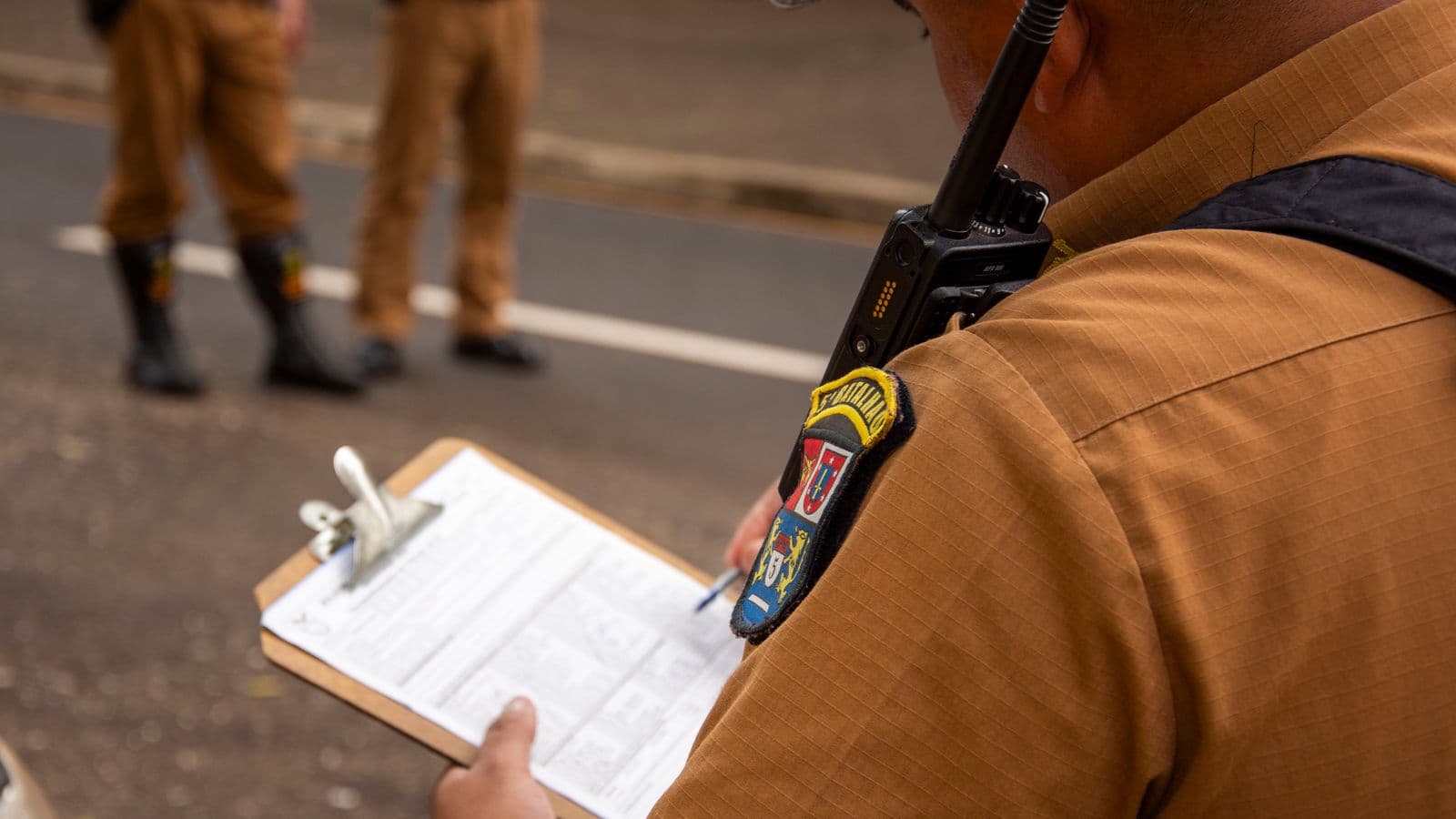
A delivery driver steps down from the cab wrong, feels her knee give, and finishes the round anyway. Three days later a physiotherapist puts her on modified duties for a fortnight, nothing heavy, no long drives. Nobody called an ambulance. Nobody filled in an accident book at the scene. And yet that quiet, undramatic case is almost certainly OSHA recordable, while a much bloodier-looking injury down the corridor, stitched up and back at work the same afternoon, might not be. The word "recordable" doesn't track how the injury looked. It tracks a specific legal test, and most of the confusion around it comes from assuming otherwise.
This piece sets out what that test actually is, what the current numbers say about how often it gets triggered, and where the classification most often gets mixed up with something it isn't.
What "OSHA recordable" means
Under 29 CFR Part 1904, the federal recordkeeping rule, a work-related injury or illness is recordable when an employer's own duty to log it has been triggered. It is not a measure of severity, and it is not a signal that OSHA has been informed. It is a classification: yes, this case belongs on your OSHA 300 Log, or no, it doesn't.
Three things have to be true together. The case has to be work-related under 1904.5, meaning it arose in the work environment unless one of nine narrow exceptions applies. It has to be a new case under 1904.6, rather than the flare-up of something already logged. And it has to meet at least one of the six criteria set out in 1904.7: death, days away from work, restricted work or job transfer, medical treatment beyond first aid, loss of consciousness, or a significant diagnosis from a physician. Meet all three gates and the case goes on the log. We walk through each 1904.7 criterion individually, with the section text, in our recordable criteria checklist.
That's the entity. Everything published about "OSHA recordable" is really a set of edge cases hung off that one three-part shape.
Recordable numbers are down, but the classification hasn't loosened
It's tempting to read a falling injury count as fewer recordable cases per workplace, but the two aren't the same thing, and the data is worth looking at directly rather than assuming. The Bureau of Labor Statistics' most recent Survey of Occupational Injuries and Illnesses, released 22 January 2026, put private industry's total recordable case (TRC) rate at 2.3 per 100 full-time equivalent workers for 2024, the lowest figure the series has recorded since it began in 2003.
| Year | TRC rate (per 100 FTE, private industry) |
|---|---|
| 2021 | 2.7 |
| 2022 | 2.7 |
| 2023 | 2.4 |
| 2024 | 2.3 |
Source: BLS, Employer-Reported Workplace Injuries and Illnesses, 2024
Within that 2024 total, employers reported 2.5 million nonfatal injuries and illnesses, down 3.1 percent on 2023. Cases involving days away, job transfer, or restriction (DART) still made up the bulk of the serious end: over the combined 2023–2024 period, days-away cases alone ran at an annualised 86.6 per 10,000 FTE workers, with a median of eight days away from work once a case cleared that bar. None of that trend changes what counts. A falling rate means fewer triggering events, not a looser test. The six 1904.7 criteria haven't moved, and an inspector checking your log against last month's cases applies exactly the same six questions they'd have applied in 2021.
Recordable is not reportable, and that mix-up gets expensive
The single most common error we see is treating "recordable" and "reportable" as synonyms. They're governed by different sections and answer different questions. Recordable asks whether a case goes in your own OSHA 300 Log, kept internally and produced on request. Reportable asks whether you have to pick up the phone, or now, in most cases, use OSHA's online reporting form, within a fixed window: eight hours for a work-related fatality, twenty-four hours for an in-patient hospitalisation, amputation, or loss of an eye, under 1904.39.
A case can be recordable without ever being reportable, that's the far more common pairing. A broken finger that keeps someone off restricted duty for a week is recordable the moment it's diagnosed, but it doesn't trigger the 24-hour reporting clock unless it also involves hospitalisation or amputation. Confusing the two in either direction causes real damage: treating every recordable case as something OSHA needs a call about wastes safety staff time on reports that were never due, while treating a reportable event as merely "something for the 300 Log later" misses a legal deadline that carries its own citation, separate from any recordkeeping penalty. We go through both timers, and the handful of cases that trigger both at once, in recordable vs reportable, explained.
Where the determination actually goes wrong
Three patterns come up constantly in the scenarios we've built the recordability engine against.
Assuming no missed shift means not recordable. Restricted work, medical treatment beyond first aid, and a significant diagnosis all trigger recordability with zero days away from work. An employee who never leaves the building can still generate a recordable case purely on the treatment they received or the duties they were kept from.
Letting "we sent them home to be safe" slide past as caution rather than restriction. As one EHS compliance team put it plainly, working through recordability determinations "can be very taxing" and is routinely one of the more stressful calls a safety manager makes day to day, precisely because well-intentioned caution and a formal restriction under 1904.7(b)(4) look identical from the employee's chair. If normal duties were curtailed because of the injury, for any part of a day, that's restricted work whether or not anyone used the word.
Missing that "one criterion is enough" cuts both ways. Teams sometimes look for the single worst-sounding fact and stop there, missing that a lesser criterion already settled the case earlier in the sequence. Equally, teams sometimes keep searching for a "final" answer on a fact pattern the regulation genuinely leaves open, when the honest answer is that it needs a documented judgement call rather than a guess either way.
Whether the treatment given actually crosses from first aid into medical treatment is its own frequent flashpoint, and worth its own read: we cover the full fourteen-item first aid list, and the version most published summaries get wrong, in first aid vs medical treatment, explained. Work-relatedness has a similar set of traps, covered in OSHA work-relatedness exceptions.
What happens once a case is classified recordable
A recordable classification isn't the end of the paperwork, it's the start of it. The case gets a line on the OSHA 300 Log: a case number, a short description, which 1904.7 criterion it met, and a day count if days away or restricted work apply. We cover exactly what each column expects in the OSHA 300 Log explained.
At year end, every entry on the 300 Log rolls up into the 300A summary, the establishment-wide totals that get posted in the break room from 1 February to 30 April and, for many establishments, submitted electronically to OSHA's Injury Tracking Application by 2 March. From there, the recordable count feeds your Total Recordable Incident Rate (TRIR), the metric insurers, prime contractors, and your own safety committee will actually look at, calculated against 200,000 hours worked as the standard base. We explain the exact formula, with a worked example, in our TRIR calculation guide.
Table 1 shows how that chain runs from a single injury to a public-facing number.
| Stage | What happens | Governing section |
|---|---|---|
| Injury occurs | Employer determines work-relatedness, new-case status, and the 1904.7 criterion met | 1904.5, 1904.6, 1904.7 |
| Recordable case logged | Entry added to the OSHA 300 Log within 7 calendar days | 1904.29 |
| Year-end summary | Totals roll up into the OSHA 300A | 1904.32 |
| Public posting | 300A displayed 1 Feb–30 Apr | 1904.32(b)(6) |
| Electronic submission | Many establishments submit via the ITA by 2 March | 1904.41 |
What the classification is not
Recordable is not a finding of fault. It doesn't matter whether the employee, a contractor, a member of the public, or pure bad luck caused the injury, the test runs on work-relatedness and outcome, not blame. It's also not permanent: privacy concerns can change how a case is described on the log, replacing the employee's name with "privacy case" across six defined categories, but that doesn't remove it from the count. And it's not a measure that OSHA has to approve in advance. The employer makes the call, using the criteria in 1904.7, and an inspector checks the log against those same criteria later, not the other way round.
If a case genuinely sits on a boundary the regulation doesn't resolve cleanly, the honest response is to say so and document the judgement, rather than force a confident yes or no onto facts that don't support one. That's the same principle Job13's recordability check runs on: every answer cites the exact provision it rests on, and returns needs review rather than a guess when the facts leave it genuinely open.
Frequently asked questions
What does OSHA recordable actually mean?
It means a work-related injury or illness meets at least one of the six criteria in 29 CFR 1904.7, death, days away from work, restricted work or job transfer, medical treatment beyond first aid, loss of consciousness, or a significant diagnosis, and so must be entered on the employer's OSHA 300 Log.
Is every recordable case also reportable to OSHA?
No. Recordable cases stay on your internal log unless they also meet the separate reporting triggers in 1904.39: a work-related fatality within eight hours, or an in-patient hospitalisation, amputation, or loss of an eye within twenty-four hours. Most recordable cases never reach that threshold.
Who decides whether a case is OSHA recordable?
The employer does, applying the 1904.7 criteria at the time. There's no OSHA pre-approval step; the employer's recordkeeper makes the determination and keeps the log, and it's checked against an inspector's own reading of the same rule later, not signed off beforehand.
Does first aid treatment count as recordable?
Not on its own. Treatment that stays within OSHA's fourteen-item first aid list doesn't, by itself, trigger recordability. The same injury can still be recordable on a different ground, restricted work or days away, for instance, even when the treatment given was first aid.
How many workplace injuries were OSHA recordable in 2024?
Private industry employers reported 2.5 million nonfatal recordable injuries and illnesses in 2024, a total recordable case rate of 2.3 per 100 full-time equivalent workers, the lowest the BLS series has recorded since 2003.